

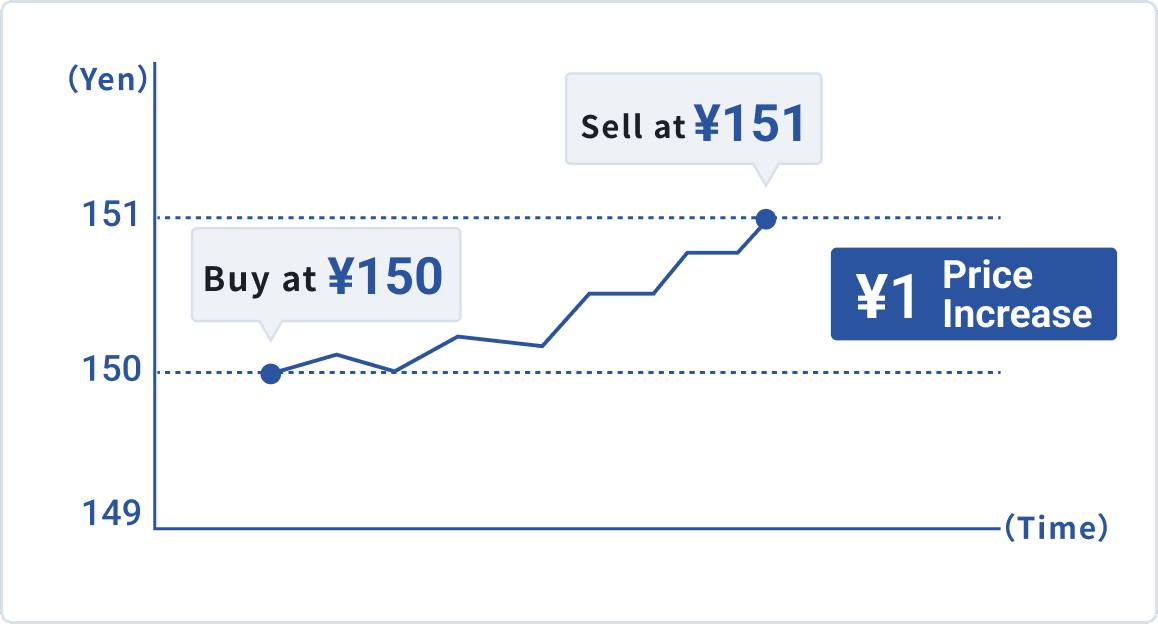
Buy (long): you expect the price to rise
Buy at 150.00, then sell at 151.00 to close
New to trading
The basics, how profit and loss are made, how to manage risk, and the path from opening an account to your first trade.
USD/JPY is the price of one US dollar in yen. The difference between the opening price and the closing price is your profit or loss. If you expect the price to rise, you buy. If you expect it to fall, you sell.
Example: trading USD/JPY at 150.00 yen per dollar
Buy at 150.00, then sell at 151.00 to close
Sell at 150.00, then buy back at 149.00 to close
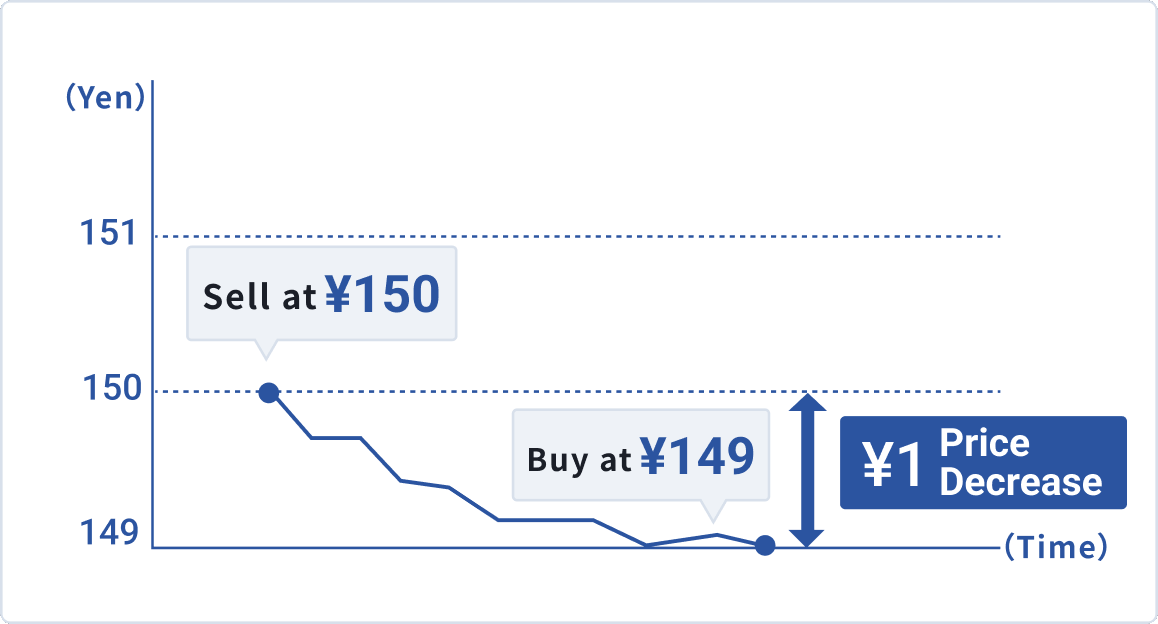
A buy loses money if the price falls. A sell loses money if the price rises. Leverage means the profit or loss is based on the full trade size, even when the margin you deposit is smaller.
FX is flexible to trade, and losses can arise just as profits can. Learn the advantages together with the risks, and start with a size you can manage.
01
From early Monday to early Saturday, markets open around the world in turn. You can trade after work or early in the morning.

02
You can buy if you expect a rise, or sell if you expect a fall. A move against that view is a loss.
03
Leverage lets you trade more than the margin you deposit. A small price move can enlarge both profits and losses.
04
A sudden move can cause a larger loss or slippage. Decide the size and the stop price before you place the order.
These six words are enough to read an order screen. You do not need to memorize every definition. Learn what each word points to on the screen.
Two currencies quoted together
USD/JPY shows how the US dollar moves against the yen.
A shared unit for comparing price moves
USD/JPY from 150.00 to 150.10 is a move of 10 pips.
The gap between the sell price and the buy price
A smaller gap keeps the cost of opening a trade lower.
The size of one trade
A larger lot increases both profit and loss. Start small.
The funds held to keep a position open
Check the required margin and the free margin before you order.
A forced close that limits a growing loss
If the margin level falls below the set level, the position is closed.
The path from opening an account to placing a trade, in the order a new trader needs it. See the whole path first, then prepare what you need.
Choose the account by how the cost works. Then choose the platform by the markets you want and the device you use.
The markets are the same. The difference is mainly the mix of commission and spread.
No commission. A straightforward cost for new traders, and for discretionary or longer-term trading.
View the Pure Spread accountSpreads from 0.0 pips. For short-term trading, scalping, and high-frequency or automated trading.
View the Raw Zero accountAfter the account type, match the platform to the markets, the features, and the device.
The first goal is to learn the flow while keeping the loss limited. Check these three points before you order.
01
Keep rent, living costs, and emergency savings separate. Trade only money you can afford to lose.
Do thisSet a trading budget first
02
A larger lot makes the same price move a larger profit or loss. Confirm the controls at a size close to the minimum.
Do thisPractice on demo, then a small lot
03
Decide where the idea is wrong before you order, and place a stop. That keeps a loss from growing with the mood of the moment.
Do thisWork back from the most you can lose
Starting out raises questions about the account, the platform, and who to ask. These are the points that make the preparation easier to follow.
01
Available for weekday enquiries
02
Easy to compare how the cost works
03
MT4, MT5, and WebTrader
There are no fees or charges for opening an account. You can complete your live account application in approximately five minutes.
You must be at least 18 years old to open an account. We cannot accept account applications from anyone under 18.
ThreeTrader offers two account types to suit different trading styles.
The Raw Zero account offers tight spreads starting from 0.0 pips, with a commission of JPY 400 (or USD 4) per lot round turn, making it ideal for active traders who prioritize trading costs.
On the other hand, the Pure Spread account has no trading commissions and features a simple pricing structure where trading costs are included in the spread.
Proof of identity:
– Passport, driver's licence or My Number card.
If you use a driver's licence or My Number card as identification, you must use a different document as proof of address.
Proof of address:
– Certificate of residence
– Bank or credit card statement
– Utility bill (water, electricity or gas)
– Mobile phone or Wi-Fi bill/receipt
Please provide documents issued within the past six months.
Yes. Demo accounts are completely free to use.
Once you have checked the basics and the risks, a live account is where real trading starts. Open an account for free and take the first trade.


